

Flat Feet in Children: What's Normal and When to Look Closer
Dr. Grayson Fox, DC
Noticed your child's feet look completely flat when they stand? Almost every young child's do. Here's how arches actually develop, what's typical, and the handful of signs that are worth a closer look.
Your child steps out of the pool, leaves a wet footprint on the pavement, and there is no curve in it at all — just a solid oval from heel to toes. Once you've seen it, it's hard to unsee. Here's the reassuring headline: flat feet in children are normal for most of early childhood. Nearly every baby is born with flat feet, and the arch is something that develops over years of standing, walking, and running. What matters is not whether the arch is there yet, but whether the foot is flexible, comfortable, and letting your child move the way they want to.
The short answer
Flat feet are typical in babies, toddlers, and young children. The arch usually begins to appear as a child moves through the preschool and early school years, and many children develop a visible arch without anyone doing anything at all. A good number of adults never develop much of one and are perfectly fine.
The question worth asking is not "does my child have an arch?" It's:
- Does the foot move? Can it flex and shape itself, or is it stiff?
- Does it hurt? Is your child complaining, or avoiding activity?
- Is it the same on both sides?
A flexible, painless, symmetrical flat foot in a child who runs happily around the yard is almost always a variation of normal. A stiff, painful, or one-sided one is worth having looked at.
Why little feet look flat
Three things are going on at once, and understanding them makes the whole picture make sense.
There's a fat pad in the way. Babies and toddlers have a plump pad of fat under the arch area. Even when an arch structure is quietly forming underneath, you cannot see it, because it is padded over. This is the single most common reason a parent looks at a toddler's foot and sees nothing but flat.
Little ligaments are naturally loose. Young children have more ligament flexibility than adults do across the whole body. That laxity lets the foot spread out under weight in a way an adult's would not.
The arch is built by use. An arch is not just a bone shape — it is held up by muscles and connective tissue that get stronger through walking, running, gripping the floor, and pushing off. Feet develop their arch by working. That is why the arch tends to appear over the same years that a child's movement gets more athletic and varied.
So when a young child looks flat-footed, you are usually looking at a normal amount of padding on top of a normal amount of flexibility, over an arch that hasn't finished being built yet.
Flexible flat feet vs. rigid flat feet — the distinction that matters
If you take one thing away from this article, make it this one. "Flat feet" describes two quite different situations, and they have very different significance.
Flexible flat feet are by far the more common. The foot looks flat when your child stands on it, but an arch appears when the weight comes off — when they sit, when they stand on tiptoe, or when you gently lift their big toe while they stand. The foot has an arch; it just flattens under load. This is the normal childhood pattern.
Rigid flat feet stay flat no matter what. No arch when sitting, no arch on tiptoe, and often less movement in the foot overall. Rigid flat feet are much less common, and they are the version that genuinely warrants a medical evaluation, because there are specific structural causes behind them.
There's a simple, entirely harmless check you can do at home: ask your child to stand up on their tiptoes. If an arch appears as they rise, the foot is flexible. That is the reassuring answer, and it's the one most parents get.
What's typically fine
The patterns that generally don't need anything more than time share a few features:
- Both feet look similar. Symmetry is reassuring.
- Your child isn't complaining. No foot pain, no leg pain that's out of proportion to ordinary growing pains, no asking to be carried more than usual.
- An arch appears on tiptoes. Flexible, as above.
- Activity is normal. They run, jump, climb, and keep up with their friends without noticeably tiring first.
- Shoes wear fairly evenly. A little inside-edge wear is common; dramatically lopsided wear is a flag.
It's also worth knowing that flat feet often run in families. If one parent has low arches, seeing the same in a child is not a coincidence — and it isn't a problem in itself.
What's worth a closer look
These are the things that move a foot out of the "watch and let them grow" column:
- Pain. In the foot, the arch, the heel, the ankle, or up into the shin and knee. Children generally don't complain about their feet without a reason.
- One side only. Asymmetry is the single most useful thing a parent can notice — one flat foot and one arched foot deserves eyes on it.
- A stiff foot. No arch on tiptoe, or a foot that resists being moved.
- Getting worse, not better. An arch that was developing and now seems to be flattening again.
- Tiring quickly or avoiding activity. A child who used to run and now asks to sit down, or who won't keep up on family walks.
- Limping, or an unusual walking pattern — including patterns like toe walking or in-toeing alongside the flat foot.
- Very uneven shoe wear, or shoes that break down on one side quickly.
- Motor milestones that seem behind alongside it — which is worth a broader look at motor development.
None of these mean something serious is going on. They mean the situation deserves a proper assessment rather than another year of wondering.
The whole-body picture
Here's the perspective we'd add to the standard "they'll grow out of it."
A foot doesn't work alone. It's the bottom of a chain that runs up through the ankle, knee, hip, and pelvis, and the whole chain is coordinated by the nervous system. How a child's foot loads the ground reflects what's happening above it — and how the foot loads the ground sends information back up.
That means two things in practice. First, if one hip has less rotation available than the other, or the pelvis sits asymmetrically, a child will adapt, and sometimes the adaptation is most visible at the feet. Second, feet are packed with sensory receptors that feed the nervous system information about where the body is in space. A foot that isn't loading well is a foot that isn't reporting well — which is part of why foot mechanics and overall coordination tend to travel together.
What we look at: how the hips and pelvis move and whether they move evenly, how weight is distributed through each foot when standing and walking, whether there's a difference in tone from one side to the other, and how coordinated the overall movement pattern is. What we're looking for isn't an arch to build — growth and activity do that. It's whether anything in the system is making it harder for your child to move well and evenly while that development is happening.
Each child is different. Our team takes a personalized approach based on what your child's nervous system and movement patterns are showing us. If your child is also dealing with things like developmental patterns or a history of head-turning preference in infancy, those are part of the same conversation.
What parents can do at home
Barefoot time, on varied surfaces. This is the most useful thing on the list. Grass, sand, carpet, a firm floor, a slightly uneven backyard — all of it gives the small muscles of the foot real work to do and real information to respond to. Florida's climate makes this easy most of the year, and Lakewood Ranch has no shortage of grass to do it on.
Don't buy arch supports on your own. Over-the-counter inserts for a flexible, painless childhood flat foot are generally unnecessary, and a stiff support can do some of the work the foot should be doing itself. There are situations where orthotics genuinely help — but that's a call for a proper assessment, not an aisle at the pharmacy.
Choose flexible shoes. For everyday wear, a shoe that bends where the foot bends, has room for the toes to spread, and isn't heavily built up under the arch lets the foot work. Save the stiff, structured shoes for when they're actually needed.
Let them do foot-y things. Walking on tiptoes as a game, picking up socks with their toes, walking on a low curb, climbing at the playground — all of it is arch-building disguised as play.
Take a video. Once or twice a year, film your child walking and running toward and away from the camera, plus a quick shot standing still from behind. Comparing over time is far more reliable than memory, and it's genuinely useful to bring to an appointment.
Trust what you're noticing. Parents catch asymmetry earlier than anyone, because you watch your child move every day. If something has been nagging at you, that observation is worth taking seriously.
Where this fits with your pediatrician
We want to be clear about this. Your pediatrician is the right first call for a foot that's painful, stiff, noticeably one-sided, or attached to a limp. They can evaluate for the specific structural and medical causes behind rigid flat feet and refer on where that's warranted, and nothing in a nervous-system-focused assessment replaces that.
What we offer sits alongside it. A pediatric assessment at Little Roots looks at how your child is moving — hip and pelvic mobility, symmetry, weight distribution, and overall coordination — which is a different question from whether the foot's structure is within the normal range. Both perspectives are useful, and they aren't in conflict.
Frequently Asked Questions
Are flat feet normal in children? Yes, for most of early childhood. Nearly all babies are born with flat feet, and the arch develops gradually with standing, walking, and running. A flexible, painless flat foot in an active child is a normal variation.
At what age should a child's arch appear? Arches typically become visible somewhere in the preschool and early school years, though the range is wide and some children take longer than others. Some people never develop a pronounced arch and have no trouble at all — which is why comfort and flexibility matter more than the calendar.
How can I tell if my child's flat feet are a problem? Ask your child to stand on tiptoes. If an arch appears, the foot is flexible — the reassuring version. The things worth having checked are pain, stiffness, one side differing from the other, tiring quickly, limping, or very uneven shoe wear.
Do children with flat feet need orthotics or special shoes? Usually not. For a flexible, painless childhood flat foot, arch supports generally aren't necessary, and flexible everyday shoes plus barefoot time on varied surfaces support natural foot development. Orthotics have a real role in specific cases — determined by an assessment, not bought off the shelf.
Can flat feet cause knee, hip, or back pain in kids? The foot is the base of a connected chain, so how it loads the ground can influence what happens above it. If your child is having leg, knee, or back complaints alongside flat feet, it's worth looking at the whole pattern rather than just the foot.
Do flat feet run in families? Often, yes. Low arches are commonly inherited, and seeing the same foot shape across generations is normal — and not a problem in itself.
Can chiropractic care help a child with flat feet? A nervous-system-focused assessment doesn't build an arch — growth and activity do that. What we look at is whether hip and pelvic mobility, symmetry, and coordination are supporting how your child moves. If our team doesn't think we're the right fit for what you're seeing, we'll tell you that plainly.
You watch your child move every single day — nobody has better information than you do. If something about how they're standing, walking, or running has been sitting in the back of your mind, you don't have to wait and wonder. Book an appointment at Little Roots Pediatric Chiropractic in Lakewood Ranch — our team will take a full look at how your little one is moving and give you honest information about what we find.
Little Roots Pediatric Chiropractic, 8209 Natures Way, Unit 117, Lakewood Ranch, FL 34202. (941) 932-4611.
Learn More
Conditions we help with
Developmental Delays
Motor milestones, speech development, cognitive processing — all of it runs through a nervous system. When that system holds structural tension, it can limit what's available to your child. Gentle care creates more capacity, and more capacity compounds.
Learn moreTorticollis & Head Shape
Head tilt, flat spots, asymmetric jaw — these are often the same story told from different angles. Gentle in-arms work helps the system release the holding pattern that's keeping your baby stuck on one side.
Learn moreRelated Services
Related Reading
Related articles
In-Toeing and Bow Legs in Toddlers: What Parents Should Know
Noticed your toddler's feet turning in or their legs curving outward? Most of the time it's a normal developmental stage. Here's what's typical, what's worth a closer look, and how to tell the difference.
Read articleToe Walking in Toddlers: When to Look Closer
Read articleGrowing Pains in Children: What They Are and How to Help
Read articleKeep Reading
More for growing families
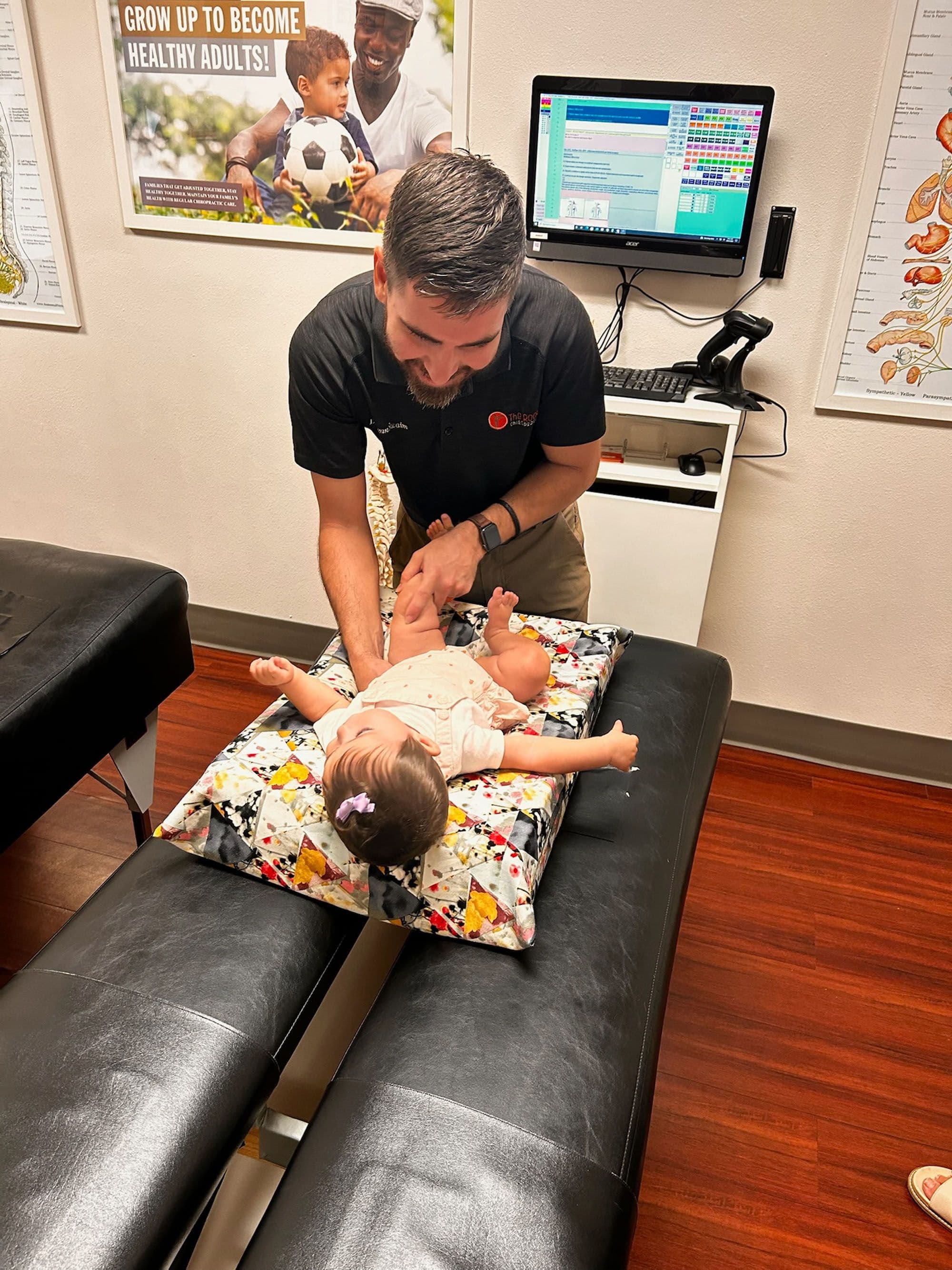
Birth-Related Stress on a Baby's Neck: What Parents Ask
Long labor, assisted delivery, or a tight fit late in pregnancy can leave parents wondering about their baby's neck. Here are the signs to notice and when to call your pediatrician.
Baby Only Sleeps on You? Understanding Contact Naps
If your baby only sleeps on you, you're not doing anything wrong. Here's why contact naps happen, what your baby's nervous system is telling you, and gentle ideas to try.
Baby Won't Take a Bottle? Gentle Troubleshooting for Parents
A baby who refuses the bottle can leave any parent frazzled. Here are the common reasons, gentle things to try, and the signs that mean it's time to call your pediatrician.
Questions about your child?
Schedule a consultation and let's talk through your family's needs together.
Book a Consultation(941) 932-4611