

Why Does My Baby Arch Their Back? What Parents Should Know
Dr. Logan Swaim, MS, DC
Babies arch their backs for all kinds of reasons — some completely normal, some worth looking into. Here's a parent's guide to what's behind it and when to seek a closer look.
If your baby has been arching their back — during feedings, when you set them down, or in the middle of the night — you've probably wondered what's going on. Some back-arching is completely normal in infants. But certain patterns are worth paying attention to, especially when they come alongside crying, fussiness, or feeding struggles.
Here's a parent-friendly guide to the most common reasons babies arch their backs and how to tell which kind you might be seeing.
Normal arching: stretch and reflex
Some back-arching is just babies being babies.
Young infants have limited ways to communicate and express themselves. Arching the back is one of the body's earliest movement patterns — connected to the Moro (startle) reflex, the natural extension reflex, and simple stretching. If your baby arches their back occasionally while awake and seems otherwise content, this is usually nothing to worry about.
Babies who are learning to control their bodies also go through phases of pushing and extending as their nervous system matures. You might notice more arching during active wake windows, as they explore what their body can do.
Arching during or after feeding
This is the pattern parents notice most often — and the one most worth looking into.
When a baby consistently arches their back during or right after feeding, it can signal discomfort. The most common causes include:
Reflux. Stomach acid traveling back up the esophagus is uncomfortable for babies, just as it is for adults. Arching is often the baby's attempt to extend the spine and relieve the burning sensation. You might also notice frequent spitting up, fussiness during or after feeding, or reluctance to take the bottle or breast. Our post on infant reflux and spit-up goes deeper into what's normal and what's not.
Overactive letdown or fast milk flow. If milk comes out too quickly, some babies arch to slow the flow or catch their breath. This tends to happen more with breastfeeding and may be accompanied by coughing, gulping, or pulling off the breast.
Latch or positioning difficulties. A latch that doesn't feel right can make feeding uncomfortable. Babies sometimes arch in response to tension in the neck, jaw, or upper back that makes certain feeding positions hard to sustain. If your baby has always seemed stiff or preferred one side, that's worth noting.
Arching when upset or crying
Arching while crying is common and often part of how babies express big feelings. When an infant is overwhelmed, overstimulated, or overtired, the whole body can go rigid — arching included.
That said, if arching during crying is frequent and intense, it can sometimes reflect:
Colic. Persistent, inconsolable crying in an otherwise healthy baby — often accompanied by gas, redness in the face, and drawing up of the legs — sometimes involves back-arching as the baby tries to relieve abdominal discomfort. The nervous-system connection in colic is something our team sees regularly. Our post on colic and the nervous system explains the connection in more detail.
Sensory sensitivity. Some babies process sensory input differently and respond to stimulation, touch, or position changes with a full-body extension. This can be a nervous-system response rather than pain-based discomfort. Our post on sensory processing in kids goes deeper into what this can look like as children grow.
Arching during sleep
Babies frequently arch and stretch during sleep — especially in active (REM) sleep when they cycle through movement. This is almost always normal and tends to settle as sleep patterns mature.
If your baby seems to arch specifically when laid flat, it can sometimes connect to reflux — lying flat makes it easier for stomach contents to move upward — or to discomfort in the spine or pelvis that makes the flat position less comfortable.
When arching may point to the spine or nervous system
This is less talked about, and we want to approach it gently — because for most babies, arching is benign.
But sometimes, consistent or asymmetrical back-arching — especially alongside other signs like preferring to look in one direction, stiffness on one side, difficulty with tummy time, or a flat spot developing on the head — can reflect tension or restricted movement in the spine or pelvis from birth.
Birth is a physical process, and even uncomplicated deliveries can leave areas of tension in the infant's spine. Torticollis — where the neck muscles are shortened on one side, causing a head tilt or rotation — is one example that's more common than many parents realize. It often coexists with a tendency to arch or consistently look one way. Our parent's guide to torticollis covers the signs in more depth.
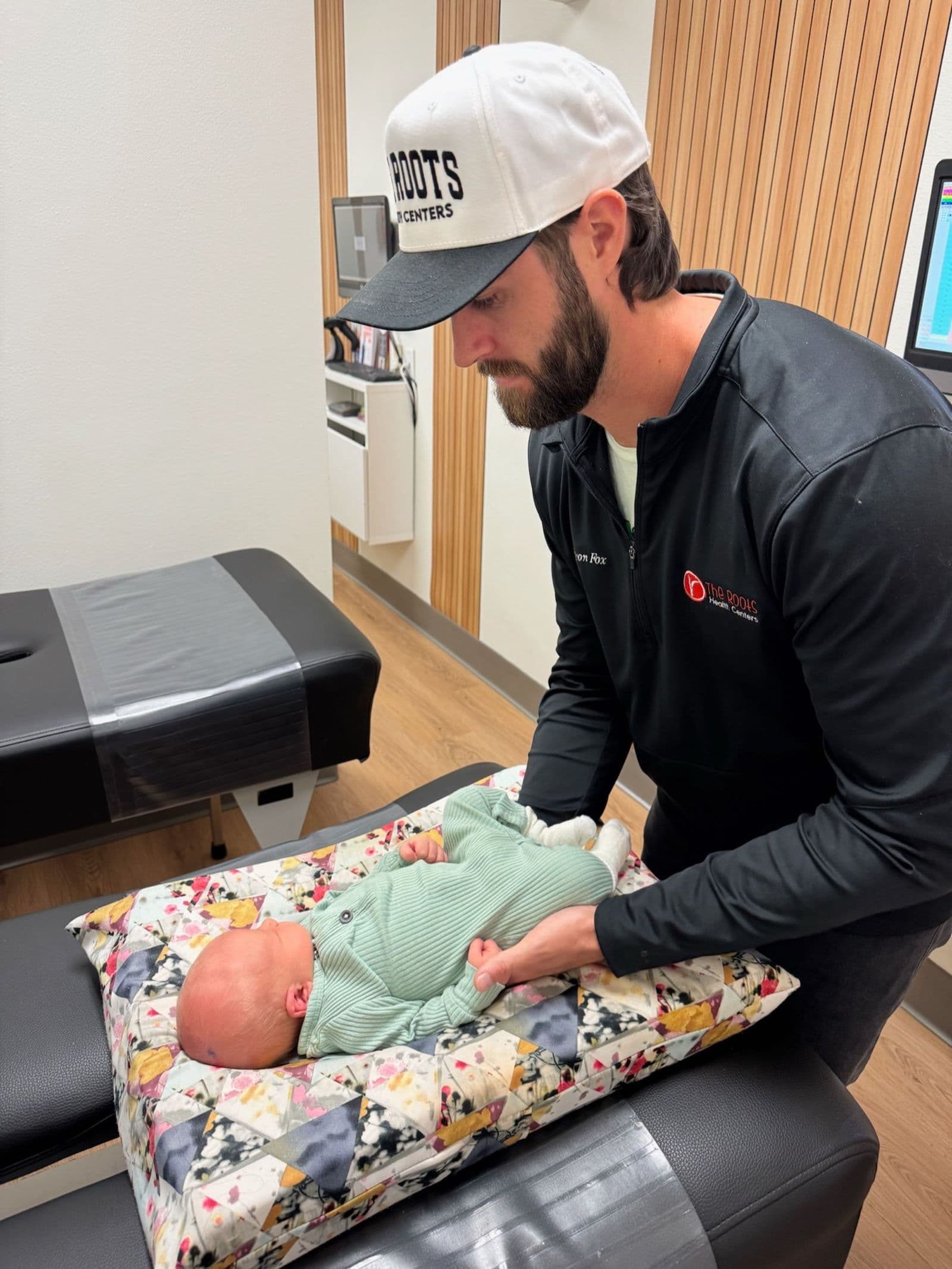
Our team does gentle evaluations for infants to assess spinal movement, nervous-system tone, and how the body is adapting. The approach used with babies is nothing like an adult adjustment — it is a light, fingertip-level contact along the spine and pelvis. Many parents are surprised by how gentle it is. If you're curious what a visit actually involves, our guide to what a pediatric chiropractor does walks through it step by step.
When to have your baby evaluated
You know your baby best. Trust your instincts. Consider bringing your baby in for an evaluation if:
- The arching is frequent, intense, or seems to be getting worse over time
- It comes alongside significant feeding difficulties, excessive crying, or poor weight gain
- Your baby seems to prefer one side, has limited neck rotation, or is developing a flat spot
- Something just feels off and you are not sure why
You do not need a specific diagnosis to bring it up with our team. That is exactly what an evaluation is for — not to alarm you, but to give you real information about what your baby's nervous system is showing us. Each child is different, and we take a personalized approach based on what we find.
Frequently Asked Questions
Why do babies arch their back when crying? Arching during crying is a normal bodily response — a full-body extension that babies use to express distress. In persistent or intense cases, it can sometimes be associated with colic, gas discomfort, or sensory sensitivity.
Is back-arching a sign of reflux in babies? It can be. When arching happens consistently during or right after feeding — especially alongside frequent spitting up or fussiness — reflux is one of the more common causes worth discussing with your pediatrician.
Why does my baby arch their back during feeding? The most common reasons are reflux discomfort, fast milk flow, or difficulty with latch and positioning. If it happens with every feeding and seems to involve real distress, a closer look at both feeding mechanics and the baby's neck and upper spine is worth considering.
What is torticollis and could it cause back-arching? Torticollis is a condition where the neck muscles on one side are shortened, causing the head to tilt or rotate. It is common in newborns and can contribute to asymmetrical arching or consistent preference for one direction. An evaluation can identify it early, when supporting the spine is most effective.
Is pediatric chiropractic safe for babies? Yes — when performed by a trained pediatric chiropractor. The force used with infants is extremely light, nothing like an adult adjustment. Our team has advanced training in pediatric care and works with babies regularly.
Could sensory processing differences cause frequent arching? Some babies who process sensory input differently respond to touch, motion, or position changes with more noticeable full-body movements, arching included. This is usually a nervous-system pattern rather than a sign of pain, though it's worth mentioning at a well visit or evaluation if you notice it consistently.
Will my baby cry during an evaluation? Some babies fuss, and that's normal — being handled by someone new, even gently, can be enough to trigger a cry on its own. It isn't a sign of pain. Our team works slowly, explains what we're doing as we go, and adjusts our pace to your baby's comfort.
Wondering what your baby's nervous system is telling you?
If you've noticed a pattern with your baby's arching — especially alongside feeding challenges, a neck preference, or general fussiness — our team at Little Roots Pediatric Chiropractic is here to take a look.
A first visit includes a gentle evaluation of your baby's spinal movement, nervous-system tone, and how their body is adapting. We go slowly, explain everything, and always take a personalized approach based on what your child's nervous system is showing us.
If the arching keeps up, a gentle infant chiropractor evaluation can check whether body tension is contributing — and give you a clear answer either way.
Our $99 new-patient evaluation includes a consultation, full neurological evaluation, and doctor's recommendation. Book a new-patient evaluation at Little Roots — or reach out with questions. We love hearing from parents.
Learn More
Conditions we help with
Colic
Colic isn't a personality trait — it's often a baby's nervous system stuck on high alert. Gentle chiropractic care helps the system downshift so feeding, sleeping, and being held start to feel okay again.
Learn moreReflux
Spit-up is normal. Arching through feeds, crying after eating, sleeping fitfully, and never seeming satisfied — that's reflux, and it's almost always a nervous-system regulation story before it's a digestion story.
Learn moreTorticollis & Head Shape
Head tilt, flat spots, asymmetric jaw — these are often the same story told from different angles. Gentle in-arms work helps the system release the holding pattern that's keeping your baby stuck on one side.
Learn moreRelated Services
Related Reading
Related articles
Colic and the Nervous System: Why Your Baby Can't Stop Crying
Colic is often a nervous system problem, not a stomach problem. Learn why babies get colic, what's really happening, and how gentle pediatric chiropractic care helps.
Read articleInfant Reflux and Spit-Up: What's Normal, What's Not
Most infant reflux is normal. Here's how to tell a happy spitter from reflux that's distressing your baby, plus gentle tips and red flags.
Read articleFlat Head Shape and Torticollis in Babies: The Connection Parents Should Know
A flat spot on your baby's head and a favorite head tilt often go together. Here's what plagiocephaly and torticollis are, why they connect, and how gentle care can help.
Read articleKeep Reading
More for growing families

Baby Only Sleeps on You? Understanding Contact Naps
If your baby only sleeps on you, you're not doing anything wrong. Here's why contact naps happen, what your baby's nervous system is telling you, and gentle ideas to try.

Baby Won't Take a Bottle? Gentle Troubleshooting for Parents
A baby who refuses the bottle can leave any parent frazzled. Here are the common reasons, gentle things to try, and the signs that mean it's time to call your pediatrician.

Baby Constipation: What's Normal and Gentle Ways to Help
Straining, fussing, and hard little poops can worry any parent. Here's what's normal for babies, gentle ways to help, and when it's time to call your pediatrician.
Questions about your child?
Schedule a consultation and let's talk through your family's needs together.
Book a Consultation(941) 932-4611