

Flat Head Shape and Torticollis in Babies: The Connection Parents Should Know
Dr. Logan Swaim, MS, DC
A flat spot on your baby's head and a favorite head tilt often go together. Here's what plagiocephaly and torticollis are, why they connect, and how gentle care can help.
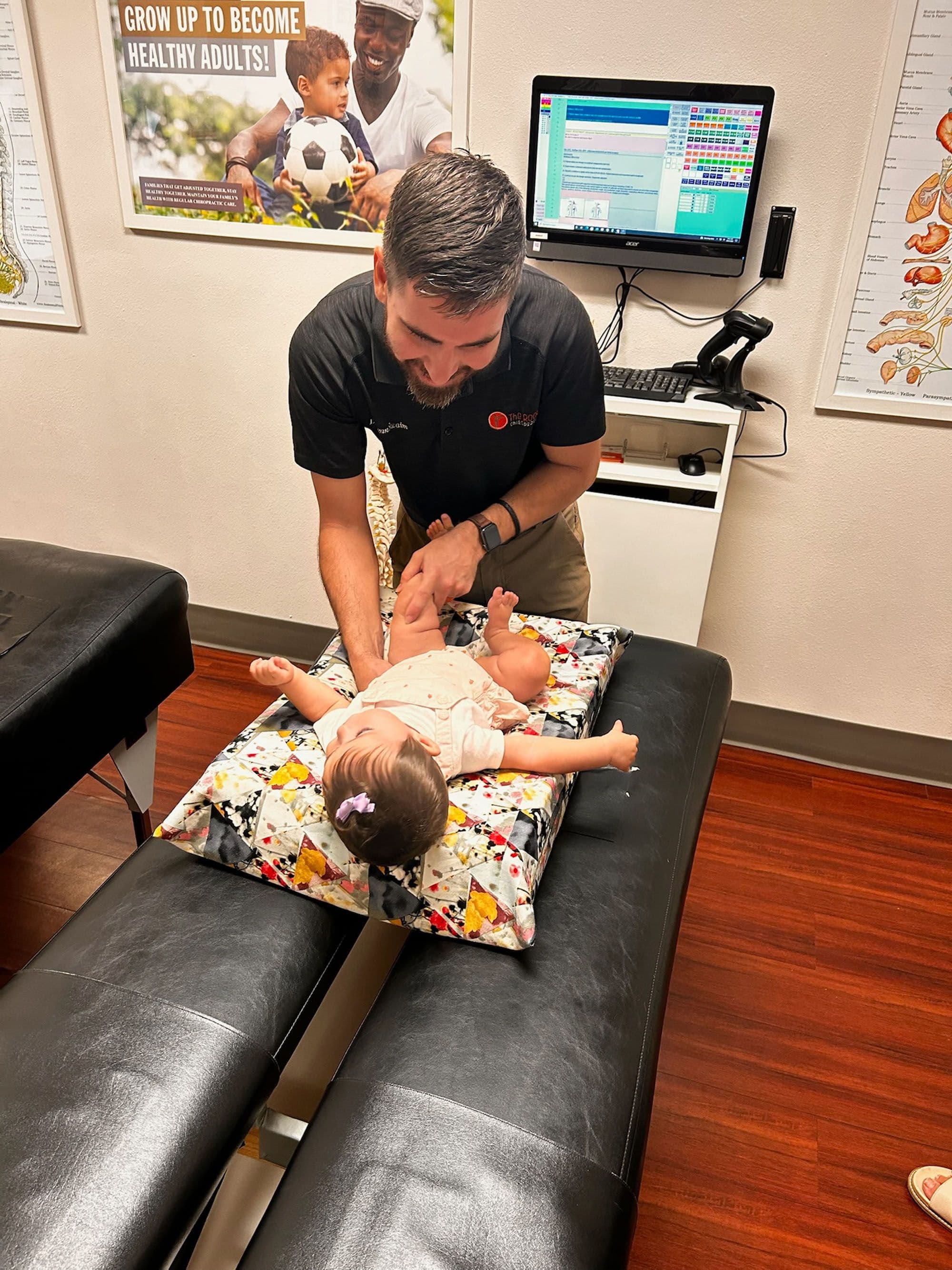
You noticed it during a diaper change or in a sweet photo from the side: one part of your baby's head looks a little flatter than the rest, and maybe your little one keeps turning their head the same way every time. First, take a breath, mama. What you're likely seeing is plagiocephaly (a flat or asymmetrical spot on a baby's soft, fast-growing skull) and it often travels alongside torticollis (a tightness on one side of the neck that makes your baby prefer looking in one direction). These are common, they're usually gentle to address, and noticing them this early is genuinely a good thing. At Little Roots Pediatric Chiropractic in Lakewood Ranch, FL, we help families understand what's happening and support babies with gentle infant chiropractic care designed for tiny, delicate bodies.
This guide walks you through what each one is, why they so often show up together, simple tummy time tips you can start today, and what gentle care looks like. No fear, no pressure, just clear answers.
What plagiocephaly and torticollis actually are
Your baby's skull is soft and moldable on purpose. It needs to flex to be born and to make room for a rapidly growing brain. That softness is wonderful, but it also means steady pressure on one spot, like resting in the same position for long stretches, can gently flatten that area over time. That flattening is plagiocephaly, sometimes called flat head syndrome.
Torticollis is about the neck. A band of muscle on one side (the sternocleidomastoid, the long muscle running from behind the ear to the collarbone) can be tighter or shorter than the other side. When that happens, your baby finds it easier and more comfortable to turn or tilt their head one way, and harder to turn the other. You might call it their "favorite side."
Neither of these means you did anything wrong. Babies spend a lot of time lying down, and a head-turning preference can begin before birth or in the early weeks. They're patterns, not failures.
What it might look like at home
Every baby is a little different, but here are the signs parents most often notice:
- A flat or slanted spot on the back or one side of the head
- One ear that sits slightly more forward than the other
- A strong preference for turning the head to one side, even during feeding
- A subtle head tilt, with one ear leaning toward the shoulder
- Fussiness or arching when you try to turn their head the "hard" way
- Trouble settling on one breast or one bottle position
- A small bald patch where the head rests most
If a few of these feel familiar, you're in exactly the right place. These are the everyday clues that the flat-head shape and the neck tightness may be connected, the link we'll unpack next.
Why the two so often go together
Here's the connection that surprises a lot of parents: the flat head and the head tilt usually feed each other.
If your baby's neck is tight on one side (torticollis), they'll naturally rest their head in the same position again and again, because that's what's comfortable. All that repeated pressure on one spot can gradually flatten it (plagiocephaly). And once a flat spot forms, the head tends to settle into that little "valley" even more, which reinforces the same head turn. It becomes a gentle loop.
What can contribute
Several ordinary things can start or feed the cycle:
- A snug position in the womb or a baby who ran low on room near the end of pregnancy
- A long or assisted delivery that left a little tension in the neck
- Lots of time on the back (which is the right and safe way to sleep) without enough variety in waking positions
- Plenty of time in car seats, swings, and bouncers, where the head rests against a firm surface
Why early notice helps
Because a baby's skull is so moldable in the early months, this is a season where small, consistent changes can make a meaningful difference. That's why noticing now, rather than later, is something to feel good about, not anxious over.
When to seek prompt medical care
Gentle chiropractic care is meant to complement your child's medical care, never replace it. Your pediatrician is an essential part of your team, and there are moments to check in with them or seek prompt medical attention.
Please loop in your pediatrician or a medical provider if you notice:
- A flat spot that seems to be getting noticeably worse, or a head shape that looks significantly asymmetrical
- A head tilt paired with a small lump or knot in the neck muscle
- Limited head movement that doesn't ease with gentle repositioning
- Any concern about your baby's vision, swallowing, breathing, or feeding
- Missing motor milestones or a sense that one side of the body is much weaker
If you're ever unsure, ask. Working alongside your pediatrician means your baby has the fullest, safest circle of support. A flat-head and torticollis pattern can sometimes overlap with developmental delays or early motor delays, so it's worth keeping your whole care team in the loop.
Tummy time tips that genuinely help
Tummy time is one of the most powerful, free tools you have, and it does double duty here: it takes pressure off the back of the head and helps strengthen the neck so both sides get stronger and more balanced.
If tummy time has felt like a battle, you're not alone. Try these gentle approaches:
- Start tiny. Even one or two minutes a few times a day counts. Build up as your baby tolerates it.
- Use your chest. Lie back and let your baby lie tummy-down on you, face to face. It's tummy time and bonding at once.
- Get down on their level. A toy, a mirror, or your singing face encourages them to lift and turn toward the harder side.
- Encourage the non-favorite direction. Place toys, light, and your voice on the side they turn to least, so reaching that way becomes a happy habit.
- Switch it up all day. Alternate which end of the crib you lay them in, which arm you feed from, and how you carry them, so no single spot takes all the pressure.
Little, consistent moments beat one long, frustrating session every time.
How we help at Little Roots
When you bring your baby in, the first thing we do is slow down and listen, to you and to your little one's body. There's no rush and no scary equipment.
A gentle, careful evaluation
We begin with a thorough look at how your baby holds, turns, and tilts their head, plus a hands-on check of where tension is sitting. We also perform a neurological evaluation to understand how your baby's nervous system is working, since the nerves that run through the neck and spine influence how freely they move. It's all gentle observation, nothing your baby needs to brace for.
Low-force, baby-sized care
For infants, our care looks nothing like the firmer adjustments you may picture for an adult. We use gentle, low-force pediatric techniques, often no more pressure than you'd use to check the ripeness of a tomato. The goal is to support easier, more balanced movement on both sides and to help ease the tightness that can keep that head-turning loop going. Because every baby is different, we take a personalized approach rather than a one-size-fits-all plan.
Support, not promises
We can't promise a specific result or a specific number of visits, and we'd never try to. What we can offer is attentive, gentle care, plenty of at-home guidance, and a calm partner in this season. You can learn more about our broader approach to pediatric wellness, and if a head tilt is your main worry, our guide to torticollis in babies and our torticollis care page go deeper.
Where to start in Lakewood Ranch
If you've been studying your baby's head shape in the mirror and wondering whether to do something, this is your gentle nudge: a simple visit can give you clarity and a plan, and clarity is such a relief.
Families across Lakewood Ranch trust us with their littlest ones, and we're proud to be part of a clinic rated 4.8 stars from 625+ Google reviews. We'd be honored to meet your baby. When you're ready, you can book an appointment at our Lakewood Ranch office, or reach out through our contact page if you'd like to ask a question first. We're at 8209 Natures Way, Unit 117, and you can also call us at (941) 932-4611.
You're already doing the most important thing, paying close, loving attention. Let us help you take the next gentle step.
Frequently Asked Questions
Will my baby's flat head round out on its own?
In the early months, a baby's skull is wonderfully moldable, and small daily changes like varied positioning and tummy time often support a more even shape over time. Because every baby is different, a gentle evaluation can help you understand your little one's specific pattern and what may help most.
Does gentle chiropractic care for babies hurt?
No. The care we use for infants is extremely gentle and low-force, often lighter than the pressure you'd use to test a ripe tomato. Many babies relax, settle, or even fall asleep. Nothing about it resembles the firmer adjustments people often picture for adults.
Can I just reposition my baby and skip everything else?
Repositioning and tummy time are powerful and we'll always cheer them on. But when neck tightness (torticollis) is part of the picture, addressing that tightness alongside repositioning can help break the loop more comfortably. Pairing at-home habits with gentle care often gives babies the best support. We always recommend working alongside your pediatrician, too.
How early can my baby be seen?
Babies can be seen very early, and many parents come in during the first weeks once they notice a head-turning preference or flat spot. Earlier attention takes advantage of how moldable a young skull is. There's no need to wait until you're certain something is wrong.
Is a flat head just cosmetic, or does it matter more?
Many flat spots are mild and largely about shape. But because flat-head patterns often connect to neck tightness and movement habits, they can sometimes overlap with how a baby reaches, turns, and meets early motor milestones. That's why we look at the whole picture, not just the shape, and partner with your medical team when needed.
What should I bring to our first visit?
Just your baby and your questions. It helps to jot down what you've noticed, like which side they favor, when you first saw the flat spot, and any feeding quirks. Comfortable clothing for your little one is great. Everything else, we'll walk you through gently when you book an appointment.
Learn More
Conditions we help with
Torticollis & Head Shape
Head tilt, flat spots, asymmetric jaw — these are often the same story told from different angles. Gentle in-arms work helps the system release the holding pattern that's keeping your baby stuck on one side.
Learn moreDevelopmental Delays
Motor milestones, speech development, cognitive processing — all of it runs through a nervous system. When that system holds structural tension, it can limit what's available to your child. Gentle care creates more capacity, and more capacity compounds.
Learn moreRelated Services
Keep Reading
More for growing families
Nursing Strikes: Why Babies Suddenly Refuse the Breast
One day nursing is going fine, the next your baby won't latch at all. Here's what a nursing strike actually is, common triggers, and how to get through it.
Baby's Crooked Smile or Asymmetrical Face: What It Can Mean
A crooked smile or uneven face in a newborn is common and usually has a simple explanation. Here's what typically causes it, and when to loop in your pediatrician.
Head Shape and Helmet Therapy: When It's Needed — and When It Isn't
A flat spot on your baby's head can be alarming to notice. Here's how head shape typically develops, when helmet therapy is genuinely needed, and what else may help first.
Questions about your child?
Schedule a consultation and let's talk through your family's needs together.
Book a Consultation(941) 932-4611