

Plagiocephaly: What to Do About a Baby's Flat Head
Dr. Grayson Fox, DC
A flat spot on your baby's head is common and usually manageable at home. Here's what causes it, what actually helps, and when to loop in a specialist.
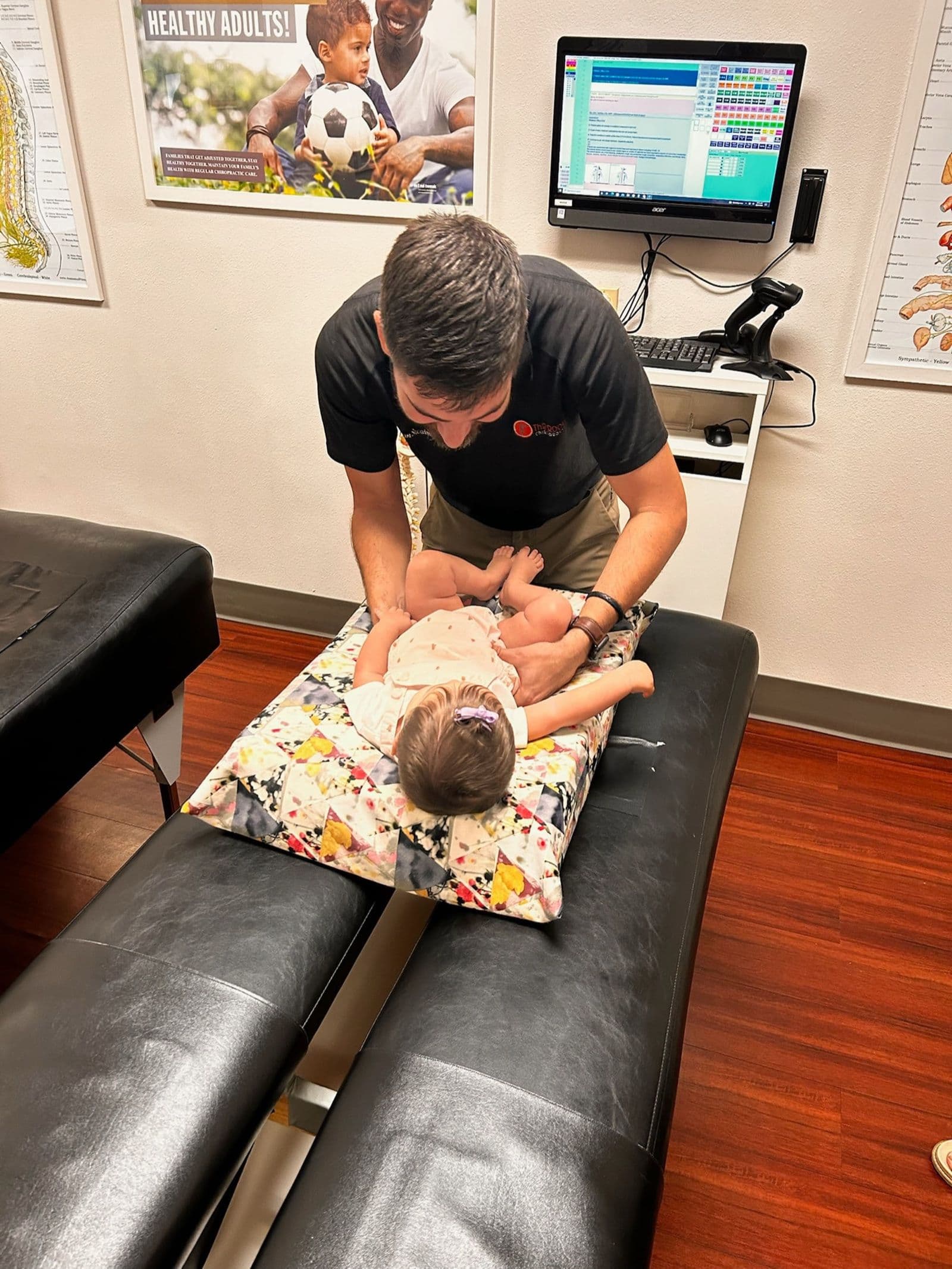
If you've noticed a flat spot on the back or side of your baby's head, take a breath — this is one of the most common things pediatricians and pediatric chiropractors see, and it's usually very manageable. A flat head in a baby, known medically as plagiocephaly, develops because a newborn's skull is soft and still forming, and enough time spent in one position — in a crib, a car seat, or a swing — can gradually flatten the area under the most pressure. The good news is that most cases respond well to simple changes at home, and there's a clear path to follow if more support is ever needed.
What Causes a Flat Head in Babies
The most common cause is simple physics: a soft skull plus sustained pressure in one spot. Back-sleeping — which is correctly recommended for safe sleep and reduces the risk of SIDS — means babies spend a lot of hours on the back of their head, and that alone accounts for a large share of cases. Time in car seats, bouncers, and swings adds more of the same kind of pressure. Some babies also have a natural preference for turning their head one direction over the other, which concentrates the flattening on one side rather than spreading it evenly across the back of the head.
Plagiocephaly and Torticollis: Why They Often Show Up Together
A baby who consistently turns their head to one side isn't always doing it by preference — sometimes it's because turning the other way is uncomfortable or restricted. Torticollis is tightness or restriction in the neck muscles that makes it harder to turn the head fully in one direction, and it's one of the more common underlying reasons a flat spot develops unevenly on one side rather than centered at the back. If your baby seems to strongly favor one side — during feeding, sleep, or tummy time — that's worth mentioning at a visit, because addressing the underlying neck restriction is often what actually stops the flat spot from progressing, rather than repositioning alone.
Repositioning and Tummy Time: The First Line of Care
For most babies, the first and most effective approach is simply reducing time spent on the flat spot. A few things that tend to help: alternating which end of the crib your baby's head is closest to, so they naturally turn toward the room from a different angle each night; changing the direction you approach the crib for pickups and soothing, since babies often turn toward a familiar sound or face; and limiting long stretches in car seats, bouncers, and swings when you're not actually traveling. Supervised tummy time is one of the most useful tools available — it takes pressure off the back of the head entirely while also building the neck and shoulder strength that makes side-to-side head turning easier and more even.
When a Helmet Might Come Up
For most babies, repositioning and tummy time are enough, and the flat spot gradually improves as the child spends less time on their back and more time upright, sitting, and moving. In more pronounced or persistent cases, a pediatrician may refer a family to a craniofacial specialist to discuss a corrective helmet, which works gradually over months by guiding skull growth into a more even shape. That decision belongs with your pediatrician and a specialist trained to evaluate skull shape directly — it isn't something we diagnose or recommend from a chiropractic visit, and we'll always point you toward that conversation if what we're seeing suggests it's worth having.
What We Look At During a Visit
When a family comes in with concerns about a flat spot, we're not just looking at head shape — we're looking at how well your baby can turn, tilt, and move their head and neck in every direction, using a gentle, pediatric wellness evaluation built specifically for infants. If we find restriction or asymmetry consistent with torticollis, we use extremely light, hands-on techniques appropriate for a newborn's developing spine to help support more even, comfortable movement — nothing resembling an adult adjustment. We won't promise a specific timeline for improvement; every baby's case is different, and our approach is based on what your baby's own evaluation shows.
Everyday Habits That Help
A few small habits add up over weeks: give your baby supervised tummy time several times a day, starting with just a few minutes at a time and building up as they tolerate it; hold and carry your baby facing outward or upright when you can, so they're not spending awake time on the back of their head too; switch which arm you use for feeding and holding from time to time, so your baby isn't always turning the same direction to find you; and offer toys or interact from the side your baby turns toward less, gently encouraging more balanced movement. None of these need to be perfect — consistency over a few weeks matters more than any single session.
Frequently Asked Questions
Will a flat spot go away on its own? Often, yes — especially mild flattening that's caught early, since a baby's skull is still soft and responsive to reduced pressure and increased tummy time. More pronounced flattening benefits from active repositioning and, sometimes, a specialist's input.
How do I know if it's torticollis and not just a sleep preference? A baby with torticollis usually shows a consistent, fairly strong preference for one side across feeding, sleep, and tummy time — not just an occasional favorite direction. If turning one way seems to cause fussiness or real difficulty, that's worth having looked at.
Is a flat head a sign of a bigger problem? Usually not — positional plagiocephaly is a shape issue related to pressure and positioning, not a sign of a developmental or cognitive problem. It's a cosmetic and mechanical concern in the vast majority of cases.
When should I talk to my pediatrician about a helmet? If repositioning and tummy time haven't made a noticeable difference after a few weeks to a couple of months, or if the flattening looks significant, that's a reasonable time to raise it with your pediatrician, who can refer you for a specialist evaluation if appropriate.
Can pediatric chiropractic care fix a flat head by itself? We don't treat head shape directly — that's outside our scope. What we can do is gently support neck mobility and reduce restriction that may be contributing to a one-sided pattern, alongside the repositioning strategies that do the most direct work on head shape itself.
If your baby seems to favor one side, or you'd like a gentle second set of eyes on their head and neck movement, we're happy to take a look. Book an appointment at Little Roots Pediatric Chiropractic in Lakewood Ranch.
Little Roots Pediatric Chiropractic, 8209 Natures Way, Unit 117, Lakewood Ranch, FL 34202. (941) 932-4611.
Learn More
Conditions we help with
Related Services
Related Reading
Related articles
Tummy Time: Why It Matters, Why Babies Resist It, and How to Make It Work
Tummy time resistance is one of the most common new-parent concerns we hear at Little Roots. Here's when to start, how much to aim for, and when struggles are worth a closer look at your baby's nervous system.
Read articleThe Moro (Startle) Reflex in Babies: What's Normal and What to Watch For
That sudden fling-the-arms-out startle has a name — the Moro reflex. Here's what's normal, why it happens, and when it's worth a closer look.
Read articleKeep Reading
More for growing families

What to Expect at Your Baby's First Pediatric Chiropractic Visit
A step-by-step walkthrough of what actually happens at your baby's first pediatric chiropractic visit — the conversation, the gentle evaluation, and what care looks like for an infant.
Seasonal Allergies in Kids: A Gentle, Nervous-System-Supportive Approach
Seasonal allergies in kids often show up as a runny nose, congestion, or a child who just seems "off" for weeks. Here's what's happening and gentle, drug-free ways to offer support.
Silent Reflux in Babies: The Reflux You Can't See
Not all reflux comes with spit-up. Silent reflux can cause real discomfort with none of the obvious signs — here's what parents should know.
Questions about your child?
Schedule a consultation and let's talk through your family's needs together.
Book a Consultation(941) 932-4611